How I Ignite a Love of Learning by Customizing Curriculum
Hope you all are doing well! Anita just graduated Cum Laude with her Bachelors in Psychology with a Concentration in Theology from the University of Dallas in 3 years! Congratulations Anita! We are proud of you! She has decided to give the next 2 years for our Lord, by working full-time as a FOCUS Missionary, ministering to students on campus. We just returned from Dallas from attending her graduation, and the coming weekend also, we will be at Dallas to attend a Priestly Ordination for one of our dear friends from the Jesus Youth Movement. Our school year is entering a final push as we try to finish up a few more lessons and wrap things up. Our 11th and 9th graders, Albert and Aaron, are done with their Dual Enrollment classes for the semester, but still have a couple more Socratic discussion classes based on the Dialogues of Plato. It has been a full and beautiful season, and purely God’s grace we are still standing! 😊
This is also the time of year when I start getting excited about planning for the coming year, because homeschool planning is honestly one of my favorite things. I have a post here where I shared practical steps for choosing homeschool curriculum, and I would really encourage you to read through that as a companion to this one. But in this blogpost, I wanted to share something a little different; specifically how I try to ignite a love of learning by customizing curriculum to suit each child.

God has created each child in a very unique way, with different talents, learning styles, different personalities, and a unique mission. So naturally, what works beautifully for one child will not work exactly the same for another, even within the same family. We can see that very clearly in our family of 9 kids! To me, one of the greatest gifts of homeschooling is the freedom to alter and customize curriculum to suit the child in front of you, rather than forcing every child through the exact same mold.
Our oldest is 21 now, and we have been homeschooling from the very beginning. From the start, our approach has been eclectic. I have always put together our own curriculum, blending from different philosophies and methods, trying to tailor things according to each child’s learning style, interests, and our overall family dynamics for that year. Some years we have leaned heavily classical. Other years we have leaned more Charlotte Mason. We have always encouraged self-teaching and the pursuit of personal interests, and because of that, each year has looked a little different, and each child has looked a little different from the next.
I almost never use curriculum in a rigid, one-size-fits-all way. I see it more as a tool I can adapt as needed, and I believe that has helped our homeschool tremendously. That is also one of the main reasons I have never used a boxed curriculum, because I want to maintain that flexibility to alter methodology to suit the individual child. I want to share a few practical ways I have done that over the years, with some real examples from our own home. Even if you do decide to do a boxed curriculum, you can still add things they are interested in and make some of the changes as elaborated below.
1. Start with the child, not the curriculum
When I think about planning for a child, I usually prayerfully start thinking about the actual child in front of me. What are this child’s strengths? What are the struggles? What kind of things naturally interest this child? Does this child enjoy reading, prefer hands-on work, learn better through video instruction, like discussion, need more structure, or need more room to move at their own pace? I also note down 1-2 things I feel I need to focus on that year for that child. I also ask them whether there is anything specific they want to learn that year, including extracurriculars. Though all wishes are hard to grant, it does overall shape the plan for that year.
Anita, for example, loved hands-on learning when she was younger, and was also a very strong and voracious reader. She finished the Lord of the Rings by Tolkien in 3rd grade. So with her, I leaned into longer classics and literature-rich reading as part of school. Anthony, on the other hand, was mostly drawn to non-fiction, business, and finance type books from around 5th grade onwards. If I had been fixated on giving him a classic literature-heavy reading list, it may not have sparked the same hunger to keep reading and learning. When Anthony applied to Community College in 8th grade, the Dean was genuinely impressed by his reading list. He was able to finish his 4-year Bachelor’s degree in Business Management at the age of 18! Similarly, Abel has always had a real love for birds, so when he asked about Ornithology classes for that year, we enrolled him in the Cornell Lab of Ornithology course, which he loved. Albert found a love for coding through a random coding book in our home library, so we added Python classes for him at his request. Agnes also wanted to do a Greece study, so I allowed her to do that on top of the regular history curriculum she was expected to listen in.
2. Use passions and interest as a doorway to deeper learning- One thing I have seen over and over in our own family is that children come alive when learning connects to something they already care about.
This does not mean every lesson has to revolve around a hobby, but I do think interest can be used very wisely as a doorway into deeper learning. Anita had a real passion for baking and decorating from a young age, so we incorporated baking and cake decorating classes from different platforms alongside her regular schoolwork. She had made 4 wedding cakes by the age of 19! Like I mentioned, Anthony was drawn to business, and finance type books from around 5th grade onwards. As per his interest, I added courses in those fields by subscribing to different platforms, so he could build a solid base. He took his learning to the next level, by setting up his own company by the age of 15. He currently works in his company in Real Estate Finance full time. When we took a family trip to Rome, we did a full Rome study beforehand as all the kids were very excited for the trip; so the trip became a living classroom for everyone.
3. Customize the output, not just the content- Same curriculum, same topic, but different output for different children can make a huge difference.
Again, Anita and Anthony are a great example of this. Both used the same science curriculum one year, but Anita did lapbooking because she was a more hands-on, visual learner at that time, while Anthony wrote out notes and made flashcards, which was what worked best for him. Both learned the same material, but the way they engaged with the topic was completely different. If I had required Anthony to do lapbooks, he would have become very disinterested. On the other hand, he maintained an interest in science to the point that he periodically revisited the science topics to make flashcards and keep learning even after he completed his high school requirement through a College Biology class. The same child over the years can also develop new ways they engage with the material. Anita loved a more hands-on way of learning early on, but later developed more an interest in writing notes.
Similarly, one of our kids needed extra support with writing. Instead of continuing to push a curriculum that was not working well, I replaced it with written narrations from the Book of Virtues, which connected much better with where he was.
This year we did Dante’s Divine Comedy, mostly focusing on the themes of each Canto, as a family, and each child engaged with it differently. Some drew scenes, some completed written projects, some took notes, some did discussion. The content was the same for everyone, but the output was adapted to suit the child. That is one of the things I love most about family-style learning; you can cover the same rich material together while still meeting each child where they are. (And honestly, it is a lot more manageable than running 9 completely separate lesson plans every day! 😊)
Sometimes a child is not resistant to learning itself. Sometimes the resistance is to the way the outcome is expected. Once I adjust the method, the pace, or even just the type of output I am expecting, things can look very different.
4. Reflect on what is working, and be willing to adjust.
I try regularly to think through what is actually working and what is not. If something is consistently draining the peace out of our homeschool, I try to pay attention to that. If something looks good on paper but is not working well in real life, I try to be honest about it, even if we spent money on it, or even if it is a well-respected program. The first month of starting the new school year, is crucial in this regard.
There was one year I switched out a Math curriculum several months in. Sometimes I swap out a workbook for better books. Sometimes I cut back on busywork. Sometimes I replace written output with oral narration for a while. Sometimes I slow down. Sometimes I move faster. Very often, it is not a complete overhaul that changes things. It is just small adjustments. I also try to note down why something didn’t work, whether it didn’t fit my teaching style, or was scheduled at the wrong time of day, or required everyone to be present in a way that our schedule just does not allow. If it is something I really want to try again the following year, I look for a practical way to make it work better before putting it back on the plan. Despite having prayed, researched, chosen, and planned carefully, things may still need to be adjusted later. Sometimes a child matures during the year and is ready for more challenge. Sometimes we realize something is simply too much. Sometimes what looked realistic in July does not hold up by October. And that is perfectly ok. Just take that into consideration and be willing to make adjustments.
For me, customizing curriculum is not about constantly changing everything or chasing every new idea. It is more about thoughtful, prayerful adaptation rather than constant reinvention. There does need to be consistency, and there does need to be some sticking with things even when they are not exciting every single day. But there is also a real difference between healthy effort and unnecessary friction, and learning to discern between the two has helped our homeschool a great deal.
There is so much good Catholic curriculum out there, and I am grateful for that. But the question I always come back to is whether it is ‘filling the pail, or lighting the fire’. God made each of our children with a specific purpose, with specific gifts, and a unique mission that only they can fulfill. When we customize learning to suit the unique child God gave us, we are not just making homeschooling easier, but we are trying to cooperate with what He already has planned for them.
None of this is easy, and I will be the first to admit that! But I have found that when I stop trying to figure it all out on my own and lean on God’s grace, it becomes so much lighter, because He knows each of these children far better than I ever could. Let’s keep learning alongside our kids, adapting, praying, and trusting that He who began a good work in each of them will be faithful to complete it!
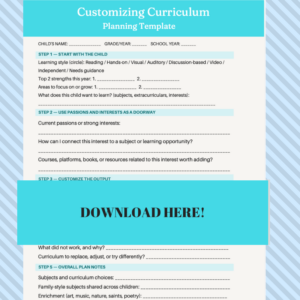
I have Customizing Curriculum planning template for you all, free to download below. God Bless! 🙏